
FAQ
What is a CRNA?
Certified Registered Nurse Anesthetists (CRNAs) provide anesthesia in collaboration with surgeons, anesthesiologists, dentists, podiatrists and other qualified healthcare professionals. When anesthesia is administered by a nurse anesthetist, it is recognized as the practice of nursing; when administered by an anesthesiologist, it is recognized as the practice of medicine. Regardless of whether their educational background is in nursing or medicine, all anesthesia professionals give anesthesia the same way.
As advanced practice nurses, CRNAs practice with a high degree of autonomy and professional respect. They carry a heavy load of responsibility and are compensated accordingly.
Where do CRNAs Practice?
CRNAs practice in every setting in which anesthesia is delivered: traditional hospital surgical suites and obstetrical delivery rooms; critical access hospitals; ambulatory surgical centers; the offices of dentists, podiatrists, ophthalmologists, plastic surgeons and pain management specialists; and U.S. military, Public Health Services, and Department of Veterans Affairs healthcare facilities.
How to Become a CRNA
It takes a minimum of 7-8.5 calendar years of education and experience to prepare a CRNA. Education and experience required to become a CRNA include:
- A Bachelor of Science in Nursing (BSN) or other appropriate baccalaureate degree.
- An unencumbered license as a registered professional nurse and/or APRN in the United States or its territories.
- At least one year of experience as a Registered Nurse in an intensive care setting. The average experience of RNs entering nurse anesthesia educational programs is 2.9 years.
- Graduation with a minimum of a doctoral degree from a nurse anesthesia educational program accredited by the Council on Accreditation of Nurse Anesthesia Educational Programs (COA). There were 121 accredited nurse anesthesia programs in the United States and Puerto Rico, using more than 1,870 active clinical sites; 91 nurse anesthesia programs are approved to award doctoral degrees for entry into practice.
- Nurse anesthesia programs are all a minimum 36 months (up to 51 months). As of July 2024, there are 141 programs with 2598 active clinical sites. Graduates have 9432 hours on average and ALL programs are now doctoral level.
- Before they can become CRNAs, graduates of nurse anesthesia educational programs must pass the National Certification Examination.
How Long Have CRNAs Been Around?
In 1893, the first anesthetic was administered by Alice Magaw, named the Mother of Anesthesia by Dr. Charles H. Mayo. In her career, she successfully administered 14,000 anesthetics without a single anesthetic-related death.
Nurse anesthetists have been the main providers of anesthesia care to U.S. military men and women on the front lines since WWI, including current conflicts in the Middle East. Nurses first provided anesthesia to wounded soldiers during the Civil War.
What CRNAs Do?
Managed care plans recognize CRNAs for providing high-quality anesthesia care with reduced expense to patients and insurance companies. The cost-efficiency of CRNAs helps control escalating healthcare costs.
Continuing Education
MAC simplifies your lifelong learning with consistency, flexibility, and a streamlined process, integrating all components into one clear program.
The MAC program comprises three main components:
MAC Ed (60 Class A Credits): Continuing education through online courses and workshops.
MAC Dev (40 Class B Credits): Development through professional activities.
MAC Check (replaces CPCA): Solidifying core knowledge through a self-paced, dynamic platform.
What is the History of WANA?
In the Spring of 1936, Spokane hospital representatives Elizabeth Scully, June Roberts, Alice Claude and Mary Leonard met at a luncheon in the Davenport Hotel. Their purpose was to form plans for the creation of an association for Nurse Anesthetists.
A few short years later, on 20 February 1939, the Washington Association of Nurse Anesthetists (WANA) was organized. Their first meeting occurred at the Davenport Hotel in May 1940.
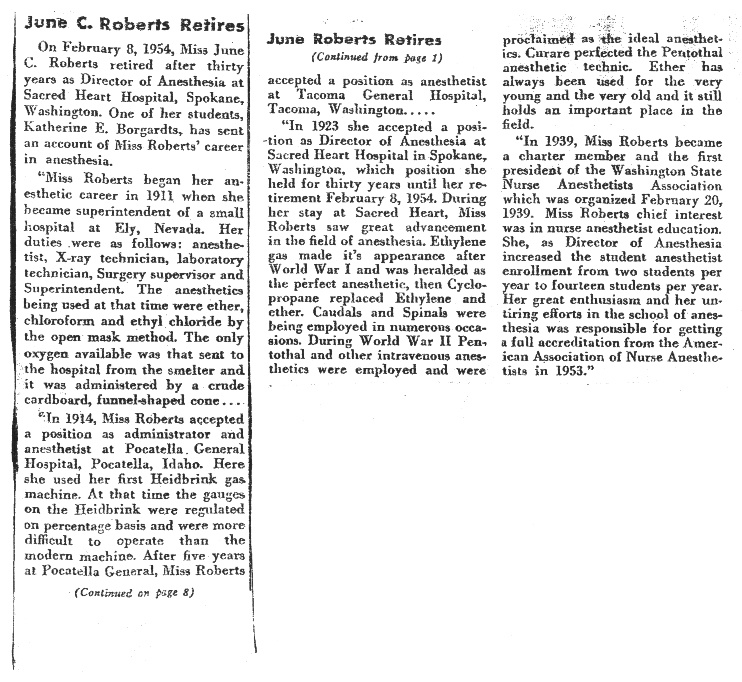
June Roberts was a charter member and first president of WANA. Her primary interest was to promote and encourage nurse anesthetist education. During her time as president of WANA, she increased anesthetist enrollment from two students per year to fourteen. June’s enthusiasm and assiduous efforts in the school of anesthesia was responsible for obtaining full accreditation from the American Association of Nurse Anesthetists in 1953. The following year, she retired after three decades as Director of Anesthesia at Sacred Heart Hospital in Spokane.
Malpractice
In 2023, the average national malpractice liability insurance premium for a self-employed CRNA was 25% less than it was in 1996. Adjusting for inflation through 2020, this reduction in premiums is even more at 71%!